Sunday, May 14, 2017

Create Your Magic Switch

When you get to my age and in my kind of work, you get to see people with so much talent but very little success. On the other hand, you’ll see people with little talents that go a long way because of their ability to apply themselves well in any endeavor they pursue. The difference between these two types of people is courage. By courage I don’t mean lack of fear but the ability to act despite it.

I don’t think it’s laziness that causes people to not apply themselves fully in their endeavors. I think It’s a lame excuse. I think it’s fear, debilitating, paralyzing fear of failure.  Some people are willing to accept that they’re lazy rather than cowards.

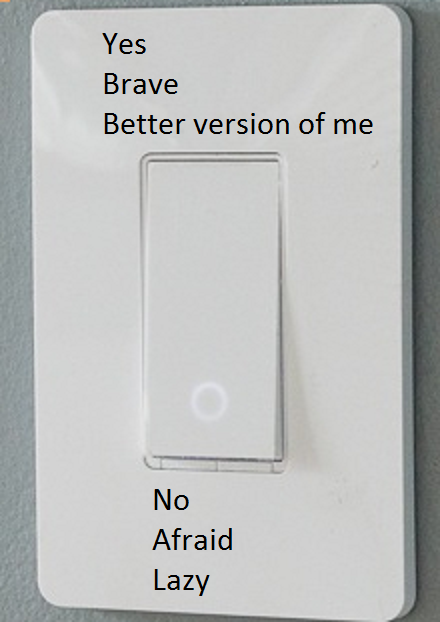
So the important question of the day is how do you overcome this debilitating and paralyzing fear of failure? I have a suggestion.  Create your magic switch.

I have always been afraid. I still have those debilitating and paralyzing fear of failure that keeps me wondering how much further I would have reached had I not allowed them to stop me from taking more risk. But I must also say that on more occasions, I was able to work my way through fear so I can face and succeed over a challenge and this is how I do it.

Step 1: Be clear about what you want to achieve in your life. Remove any doubt that you want it and that you are willing to do whatever it takes to achieve it. I want to be a successful training professional who helps people realize their full potential. Nothing’s going to get in my way   from fulfilling that goal.

Step 2: Recognize that there are certain things you fear that you will come across with and question whether you can succeed or not. Here’s a list of mine:

Tuesday, December 23, 2014

Take an Idea and Run Away With It

In this day and age of “like” buttons, it’s fairly easy to show appreciation for good ideas. We see them every day in social media and when we like them, we “like” them. And then we move on to appreciate and “like” other things. Here’s the problem, we often end with clicking the like button and nothing else. When that happens, all the good ideas we see do not contribute to our growth. 

Here’s my recommendation. When you see a good idea, pour over it, reflect on it, ask how useful it can be for you and figure out how you can apply it. Allow yourself to be excited enough by the idea to run away with it.  When Steve Jobs went to Xerox’s Palo Alto research center in the 70’s he got excited by a demonstration of  a $300 computer mouse that he pulled all stops to make a $15 mouse for Apple. Read the whole story here to find out how much more ideas Steve Jobs ran away with.

Here's a personal story. Last year, I was invited to talk about social media marketing in one of DTI's public seminars for people who are interested to start a business.  It was pretty uneventful. A few people came. I shared what I know, they asked questions, I answered  and then we're done. I was never invited again. I already forgot all about it. Last week, one of the participants connected with me on Facebook. She told me that she like what she learned from my talk last year, she is now applying it as she starts her peanut butter making and distribution business! You can just imagine my happiness on knowing that the short stint (2 hours) I had with her last year paid off! The message here is this; its not about how much knowledge you gather, it's about how you use the knowledge to pursue your goal or push an agenda.


Here are a couple of questions to get you started. What idea have you read, hear of or thought of that excited you so much lately? What did you do with it?  

Now, here’s an instruction; APPLY IT!

Wednesday, June 11, 2014

Practice Being Self-Driven

Some people thrive on recognition. I know this to be true because I am one of them. You probably are too. This is why managers should learn to inspire, appreciate other people's work and be generous with recognition.

Nothing wrong with that. However, to be paralyzed by lack of recognition or to be unmotivated because of poor supervision is self-destructive. I often hear people complain about their supervisors' lack of concern that leads to their lack of motivation or commitment to perform well.  Valid or not, having someone else to blame for one's poor performance doesn't change the fact that one is performing poorly and will likely lead to poor career outlook.

My suggestion is to learn to be self-motivated. We all need to learn to be our own source of inspiration and recognition. Being self-motivated is a good training for leadership. Up there at the helm, recognition come in trickles. You create your own source of inspiration. It often comes from the fact that you set your own challenges and the hurdles only make you strive some more. Being self-driven therefore means setting your own bar of performance and keeping your eyes on your goal in the horizon. When what you want to achieve is clear and compelling, very few things can stop you from pursuing and eventually achieving it.

Wednesday, March 5, 2014

Be Assertive

Think about it. How many times did these things happen to you?
  • You knew the answer but you did not raise your hand to answer
  • You knew the problem and had a solution in your mind but you did not speak up
  • You did not understand but you didn’t ask
  • You needed help but you did not ask or wanted to offer it but you did not reach out.

What could have been?
You could have built your reputation. You could have helped someone. You could have done better.  You could have shown leadership. You could have gotten help. Of course it could have backfired, you could have been embarrassed. But what is the price you’re paying for avoiding embarrassment?
  • An opportunity to lead
  • An opportunity to get what you want
  • An opportunity to know better
  • An opportunity to build relationship
  • An opportunity to succeed
  • An opportunity not to be afraid of being wrong

Assertiveness is the ability to speak in a manner that’s forceful but not  pushy, humble but not in a pushover manner.  Assertive is neither  aggressive nor passive. It is adult  and professional.  I enjoin you to explore it, build your skill in it, see how it  will open doors for you in the immediate and the long term.

Tuesday, December 10, 2013

Match Your Career Goals with Your Strengths

I can't imagine doing work that requires even an average amount of mathematical calculation. That's just not my strength. Imagine highly successful people like Mark Zuckerberg doing work other than what he is doing now. He would probably not be as successful. I'd like to talk about this now because I've seen too many people waste their time applying for work that clearly are not aligned with their talents. They often fail during the screening process or if the process is bad, they get hired and fail miserably at work.

I believe all people have a particular set of aptitudes that suit certain kind of work. I think it is a good investment of time and effort to discover one's strengths and then align one's career plans with it. After discovering your strengths it is important to enhance them by exposing yourself to activities that will use it similar to doing a specific exercise to grow a particular muscle. For example if you found that you are good in written communication, read books on how to become a better writer and/or write a blog to exercise your creative writing muscle. If you like dabbling into computers of programming, try working on a coding project. train yourself to expand your coding prowess.

I also highly recommend Clifton StrengthFinder. It will help you discover what strengths or "themes" you have that you can capitalize on. You can download the full list of themes here. It is also a good idea to learn more about your personality and see which careers fit you. The web is full of free online personality test. Here's a really good one.

Discovering your strengths will help you choose a career your can do well in. Find work that you can be good and enjoy doing and you will be one happy, productive worker. Your success will push you up to bigger roles in the organization that you are in. Make sure that you do not stray away from your strengths and your source of professional bliss.

Monday, December 2, 2013

Starting Ahead: Graduating with Distinct Career Advantage

Let's accept it, life is not fair. Not all graduates are created equal, Some are automatically ahead on the account of their university's name. How does one with less academic reputation build another kind of reputation that  prospective employers will find attractive?

If you are on your first year in college now, the primary thing you need to do is embrace the fact that what you will do now will have significant impact on your future. This is it! You had your fun. High school is over It's time for a little bit more seriousness.  The keyword here is decision. Decide to be a kick-ass college student. Rise above mediocrity. Remember when you graduate you will be joining hundreds of thousands of diploma-wielding  jobless individuals. Here are my suggestions for becoming a potentially awesome job candidate of the future.

Wednesday, July 18, 2012

The Whys and Hows of Online CVs


Methinks that whether you are actively looking for a job or not, you should maintain an updated online profile. Why, because it will benefit you in the near or long term. Let me share a few opportunities that can come  your way if you make yourself easily searcheable and relevant information about your skillsets, work experiences and career or business opportunities  accessible.

Prospective employers are always on the prowl for talents. They use Google and now social networks to  find the people they need. If you are happily and gainfully employed, some of these people are willing to go out of their way to find out what can make you happier and more gainfully employed. You always have the option to say no, but wouldn't you be interested to know when opportunities are just outside your door waiting to knock?

Thursday, May 3, 2012

You are Not Going to Take Risk!


Sorry for the seemingly negative title. Am I trying to capitalize on it's shock value? Maybe, but what I really want to happen is that you as well as I realize that  our unwillingness to take risk could hinder us from growing, moving forward and upward.

I have been involved in an unintended social experiment these last few months. Some of my valued employees left my pond and moved on to bigger ponds and I am left with looking for  good (hopefully better) replacements and this is where I saw some patterns.

You see, my company is small and I don't offer a lot in terms of basic salary. However, I offer a lot in terms of income opportunities and if you are enterprising, hard working, strategic minded, unafraid (or capable of overcoming initial terror) and growth oriented. You can succeed here financially and professionally such that after a year or two with me, you will have doubled your market value.

Monday, April 9, 2012

Linkedin Versus BranchOut?

First, I must say that I am no expert in anything Linkedin nor BranchOut. This is not an expert review. This is merely an opinion from someone who has been using Linkedin for a while and has recently joined and completed his profile in BranchOut in the hope that it will bring him similar businesses that he gathered from Linkedin.

I am a big fan of social media for the simple reason that my business would not have reached this point had I not discovered the web as a market place and exploited what it had to offer to the hilt (at least to the best of my abilities). As a recruiter, I found social media as a less costly yet more effective option in finding the needed talents for my clients.  Linkedin has been for the longest time our best source of talents. I'm happy that the number of Filipinos joining Linkedin is getting bigger everyday. More and more people are getting easier to find because of this. I've heard on many occasions that Linkedin is the social network of choice for professionals and business networkers. It looked like linkedin's niched juggernaut is going to be unstoppable. And then comes BranchOut, a facebook propelled social network that seem to follow the Linkedin model.

There has already been several reviews comparing both networks so I won't go that way anymore. What I really like to say is that if any or both of these networks succeed in their business, it's good for all of us job and people hunters!

Here's my word of advice, make sure that you join both and give time to complete your profile. Who knows the  opportunities you're looking for is just around the corner... or your next click!

Saturday, March 31, 2012

Enhancing Your Social Capital

They say, it matters not what you  know but whom you know. I do not  totally agree but there's certainly something to be gained with  increasing your circle of influence.

Whom you know will not help you  build the reputation which is a by  product of good work but it will open doors that will allow you to do what you need to do and spread the word about how well you do it.

Your network of highly engaged  friends and acquiantances is your social capital. The size and level of engagement determines how rich that capital is. What you need to do to increase your social capital and how to benefit from it are some of the things you can consider from this blog post.

Thursday, January 26, 2012

Karerin Mo, Bebe!

Career success comes from passionate pursuit of value creation. This means that  the more  people see the value you create for them or the organization, the more that they will want you and the more they will be willing give more to have you.

But how many of us are in the business of offering value? Not all is the kindest answer I can give. Many of us are in the business of filling a vacancy, doing whatever is minimally required to keep the job. There are several reasons why we do that. See if any of these describes you:

Wednesday, January 4, 2012

Top Interview Pitfalls and How to Avoid Them

I've done a lot of hiring in my life and my work at ExeQserve exposes me and my recruitment team to other interviewers. Our experiences taught us some good lessons about what makes a good or a bad interview. Let me share them with you here. If you have experiences that you like to share to our readers, please feel free to share them in the comments section.

Here now is my list:

  1. Being inconsistent with what's written in your CV. Some candidates put so much embelishments (read lie) in their CVs in order to get noticed. While it might get you that job interview appointment, showing signs that you lied will be your "lie-abilty." get it? 
  2. Appearing unprepared and somewhat lethargic. Some people think that all they have to do is show up.  This may sound silly but I cannot count the number of times that I felt this about a candidate. The problem is that some of these people are great or have the potential to be great at what they do, they just happen to suck  in social interaction. A job interview is a social interaction that require some social interaction skills, know what I'm saying? In your next job interview, suit up, psyche up and prepare to build rapport with your interviewer.  It's not rocket science. Read up on Neuro Linguistic Programming, specifically rapport building. It works, I tell you.

Thursday, December 29, 2011

Are You a Wall or a Bridge Builder?

Humans can be quite territorial and naturally react with some covert or overt hostilities when their personal boundaries are threatened or crossed whether wittingly or unwittingly. Because those boundaries are invisible, they get threatened or crossed all the time. Some people are more tolerant than others or better at communicating their boundaries. Those who are intolerant or poor at communicating tend to polarize people into those who are "with me" and those who are "against me."

Very few people succeed by building walls around them. The real key is building bridges with people or in simpler terms, relationship building.

As a professional interested in career success, it is important that you recognize the importance of building relationship with your boss, your peers, your subordinate and your customers. It also helps to build a strong and growing network of friends outside of your organization because your social network can open the gates to bigger and better opportunities. By offering to help instead of waiting for one and getting disappointed, you invest in strengthening relationships with others.

Tuesday, December 20, 2011

Competence + Commitment

A lot of people put their best foot forward trying to land a job. After getting that much coveted job, they lie low and lose a great opportunity to achieve career success. The reason, getting the job means being assured of the salary. And if you don't mess up or  mess things up too much you get to keep getting that salary. If you stay long enough, you might get more due to seniority.

Career success does not end in landing the job, neither does it start there. If you are still studying or just fresh out of college, this is the perfect time to read this article. If you've been in the corporate world a long time and not making any progress, this may be the best time to reflect and move onward to success.

Competence + Commitment are two important elements of career success. 

Sunday, November 27, 2011

Kaya Ko Yan!

Your career success or any other endeavor for that matter depends on how often you say "kaya ko yan" (I can do this). Nope, that's not all you need, you silly, but it starts there. CAN or on the other hand CAN'T are pretty powerful words. "Can" sets you on your way, "can't" stops you dead on your tracks.

I've been working for the last 20 years. I got to where I am now because of the number of times I said "kaya ko yan." On the other hand, I got this far also because of the number of times I said "di ko yan kaya" (I can't). I can just imagine how much farther I could have gone had I said kaya ko yan more often than I did and at times when it most mattered.

We all have that "UNKNOWN" window pane in our JOHARI window and the way to shrink it is by challenging our selves, taking some risks or sticking our neck out so to speak. You really can never tell what you can't do if you haven't tried at least once.

I wrote this because I see a lot of people who can't muster enough courage to say kaya ko yan when faced with an opportunity or a challenge. The low self expectation cause a lot of us to believe we are incapable of excellence that's why we settle for mediocre. Just imagine the possibilities if we all believe we can do better. It would mean better products, better customer experience, better quality of life.

Go get that job and then succeed in it. kaya mo yan!

Saturday, October 22, 2011

Who Do You Work For?

The logical answer of course is your employer. To say otherwise is to invite criticism that are you are being a smart aleck.

Changing the way you look at this whole idea of working for another may change your attitude about how you deal with work.

Think of it this way, you are running your own business, you are therefore working for yourself and you are your own product or service. What do your employers represent then, you may ask. They are your customers and in order for your business to flourish, you have to make them happy.  Their happiness improves the market value of your product. Your ability to do more than expected makes your product attractive both to them and other potential customers. The more attractive you are, the more people will be interested to retain your services, hence the better job pricing offers.

Friday, September 9, 2011

Are You Putting Your Strengths to Good Use?

In a book written by Marcus Buckingham entitled "Now Discover Your Strengths", he mentioned a research that showed only 20 out of 100 people work in jobs that fully utilize their strengths. If the same is true in the Philippines, it means that 80% of our workforce is not achieving their full potentials. One of those millions of people could be you or me! How do we make sure that we are on the better end of the statistics or better yet, how do we add up to the statistics of people who are doing work that fully utilize their strengths so there can be more than 20%?


Buckingham said that there are three major ingredients to one's strengths. The first one is talent. The test, strengths finder identified 36 types of talents.  They are: Achiever, Activator, Adaptability, Analytical, Arranger, Belief, Command, Communication, Competition, Connectedness, Consistency, Context, Deliberative, Developer,  Discipline, Fairness  / Empathy, Focus, Futuristic, Harmony, Ideation, Inclusiveness / Includer, Individualization, Input, Intellection, Learner, Maximizer, Positivity, Relator, Responsibility, Restorative, Self-Assurance, Significance, Strategic, Woo.  Go to this website to find out more about what they mean. http://strengthstest.com/theme_summary.php. You could demonstrate a variable number and combinations of any of those talents. You may also want to check out Richard Step's free version of strengths finder test here.

Wednesday, August 31, 2011

Of Love and Work

One of the works we do as recruiters is to separate the grains from the chaffs, the men from the boys, the ladies from the girls the haves and the have-nots, the diamonds from the coals. In the years that I've been involved in this work I have observed some patterns that separate great candidates from the mediocre ones. Is it their pleasing personality, their ability to articulate, their dilligence or is it their high IQ? I say not. This is of course not to say that these qualities do not come in handy. They do, but they are not the differentiator. You can have all these but if you don't love what you are doing your success becomes limited.

To say that you love your job  is much more than paying lip service to it. A spouse for example believes it when he/she is being loved not because of what is heard but because of what is seen and experienced.

You can tell if a person loves his work because s/he invests in getting better at it.  I'm not talking about just pursuing continuous education here. I've seen too many people who completed advanced education but have nothing to show for it in terms of quality of work. People who choose to do the things they love put every bit of what they learn to action. Well, maybe not every bit but I'm sure you know what I mean.

These people are updated, up-to-date and continually updating themselves to improve their craft. They take interest in how to do things better and search for a way to do them. If they can't find, they invent, they create.

You know you love your job when you take pride in it.  This reminds me of the "bug exterminator" character in that movie Ant Bully.  That guy demonstrated an almost obsessive take on his job. Something that is not strange for somebody who really have the love and the passion for what he is doing.  I think the best indicator of love for one's work is when one misses it in the same way tha person misses another important person.  In short, people who curse Mondays because it means returning to work are people who most likely hate their job.

Every employer wants to hire people who love their job, because these people are great at what they do and are continually getting better. According to Gallup Poll in the US, only about 20% of the working population love their job, the others either like,  indifferent or hate their work. Which side of statistic are you in? Again, it's easy to say you love your work, but the important question is how do you show it?

Tuesday, July 19, 2011

Who is Responsible for your Professional Growth?

Taking full ownership of your career development is the proactive answer to the subject matter. I'd bet that most readers would have the same answer. It's ironic, considering that the great multitude don't seem to behave in that proactive manner. It is ironic too that many of us dream of career success and yet we wait for breaks and depend on others who have more power to prepare us and then offer us the opportunity. It is of no wonder why we are often frustrated, disappointed, feeling used,  bitter and victimized by our own victim mentality.

Wednesday, June 29, 2011

What Values Do You Bring to Work?


Finding a job is easy. Succeeding in it is the real challenge.  In the last few days I met people who have all the right opportunities to make it big but failed to do so on the account of their failure to capitalize both on the opportunity and their abilities.

This happens when we fail to acknowledge the importance of what we do and why we do it. The "why" part of the last sentence gives us a sense of purpose, a motivation to give it our best, without which all we'll see is the amount of time we spend at work and the financial entitlement for those spent hours.  We fail to account for our contribution. In fact we might not even want to talk about results, just hours spent or a semblance of effort. The "whys" represent or manifest our values.

LinkWithin

Related Posts Plugin for WordPress, Blogger...